01/08/2025

Functions

Functions:

    A function is a fundamental concept in mathematics, often described as a "black box" that processes an input to produce a corresponding output. You don't necessarily need to understand the internal workings of a function to use it—simply provide an input, and the function will return the appropriate output.

Example:
    f(x) = y
In this example, x is the input (independent variable), and y is the output (dependent variable) produced by the function f.


Consider the function:
    f(x) = 2x + 5

To evaluate the function for x = 5:
    f(5) = 2 × 5 + 5
            = 10 + 5
            = 15

Therefore, f(5) = 15.

30/03/2025

Statistics

Statistics:

    Statistics is a branch of mathematics that deals with the collection, analysis, interpretation, presentation, and organization of data. It provides methods for making decisions and predictions based on data. The subject is broadly divided into two main areas:
  1. Descriptive Statistics – Focuses on summarizing and organizing data using measures such as mean, median, mode, standard deviation, and graphical representations like histograms and box plots.

  2. Inferential Statistics – Involves making predictions or inferences about a population based on a sample of data. It includes hypothesis testing, confidence intervals, regression analysis, and probability distributions.

Statistics is widely applied in fields like economics, medicine, engineering, social sciences, and business for data-driven decision-making. It helps in identifying patterns, testing hypotheses, and estimating probabilities.

29/12/2022

Relation

 Relation:

                A relation R over a set X can be seen as a set of ordered pairs (xy) of members of X.

               X= {1,2,3,4,5,6,7}

               the relation "is less than" on the set X is given by R= {(1,2), (2,3), (3,4), (4,5), (5,6), (6,7)}

                If we consider social relationships like fatherhood, brotherhood, sonhood, etc. 

                For example, Ram is the son of Dashrath, Sita was the daughter of Janak, etc.


Types of Relations:

  • Empty Relation: 

                    A relation R on a set A is called Empty if the set A is empty set.

  • Reflexive Relation:

                 A relation R on a set A is called reflexive if (a, a) € R holds for every element a € A i.e., if set A = {a, b} then R = {(a, a), (b, b)} is reflexive relation.

  • Irreflexive relation:

                A relation R on a set A is called irreflexive if no (a, a) € R holds for every element a € A i.e., if set A = {a, b} then R = {(a, b), (b, a)} is irreflexive relation. 


  • Symmetric Relation:

                A relation R on a set A is called symmetric if (b,a) € R holds when (a,b) € R.i.e. The relation R= {(4,5), (5,4), (6,5), (5,6)} on set A= {4,5,6} is symmetric.


  • Transitive Relation:

                A relation R on a set A is called transitive if (a,b) € R and (b,c) € R then (a,c) € R for all a,b,c € A.i.e. Relation R={(1,2),(2,3),(1,3)} on set A={1,2,3} is transitive.


  • Asymmetric relation:

                Asymmetric relation is opposite of symmetric relation. A relation R on a set A is called asymmetric if no (b,a) € R when (a,b) € R.

01/05/2021

Set

 Set:

         A "set" is an undefined term,but we define it as a collection of well defined objects.
        e.g. A=collection of all the students in class 5 .
P= Collection of keys in a keychain.
Etc...

Types of sets:

Null set:

      A set having no elements is known as null set.

Singleton set:

      The set having only one element is known as singleton set.

Representation of set:

   There are two ways to represent a set 
    1-Tabular form
    2-Roster form

 1-Tabular Form:

      In this form of representation sets are basically represented by capital letters (A,B,C....Z), the elements are represented by small letters (a,b,c...z) and the elements are present within a curli braces "{}" and separated by commas","  .

      A={a,b,c}  ,  P={1,2,3}  etc.

2-Roster Form:

    There are some sets which are difficult to represent in tabular form as the number of elements are vast. like the set of real numbers,sets of rational etc.

    These sets are easily representable by the help of   Roster form .

  e.g.   R={x: x is a rela number}
           N={x: x is a natural number}

Subset:

  If there are 2 sets and all the elements of the 1st set are in the 2nd one the we say that the 1st set is the subset of the 2nd one .
            A={a,b,c,d}
            B={a,b,c,d,e,f}

  Then we say that ,   A ⊆ B
And we use the symbol "⊂" to represent the proper subset.

Mathematically,
    If A ⊆ B,
    Then  x ∈ A => x ∈ B

Power set:

    The set of all the subsets of a set is called as power set of that particular set.
 e.g.
A={a,b,c}
then power set of A 
P(A)={ },{a},{b},{c},{a,b],{a,c},{b,c},{a,b,c} }

if the number of elements in a set is "n" then the number of elements on it`s power set is 2^n.


.

29/03/2021

Number System

 Number System:-

     Basically there are 2 type of number system 
              1-Real number System.
              2-Complex number System.

 Real number system:

        The real numbers is the set of numbers containing all of the rational numbers and all of the irrational numbers. The real numbers are “all the numbers” on the number line. There are infinitely many real numbers just as there are infinitely many numbers in each of the other sets of numbers. 
      There are different types of real numbers such as,
1 Natural numbers(N)={1,2,3...}
2 Whole numbers(W)={0,1,2,3...}
3 Integers(Z) ={...-3,-2,-1,0,+1,+2,+3...}
4 Rational numbers(Q)(p/q,q!= 0,p,q belongs to Z)
5 Irrational numbers(Q')(numbers which are not rational)
 
 Below is a diagram of real number system

                   
Real numbers

Complex Number System:

         Numbers which can be represented in the form of a+ib(i is a imaginary number,i=√-1)& a,b belongs to Z.
                   
Complex numbers

10/07/2020

Probability

Probability:

            Probability is the study of random or nondeterministic events.
  e.g.  if we toss a fair coin, then it results either a head or tail; of course we cannot be sure of the outcome in advance.
              N=the number of tosses
              n=the number of heads of obtained,
            P(n)=1/2

Statistical Experiment:

       A random or statistical experiment is one in which
i) all possible outcomes of the experiment are known in advance.
ii) A performance of an experiment results in an outcome which is not known in advance.
iii) the experiment can be repeated under identical conditions.

Sample space:

    The sample space of an experiment is the set of all possible outcomes of the experiment.

   e.g. if we toss a coin twice,the sample space will be 
        S={hh,ht,th,tt}

Event:

    A subset of a sample space is called an event. An event is said to occur if an element of the event occurs

   e.g. E={hh,ht}

Prob. of an event:

       If the sample space S is finite, the probability of an event A denoted by P(A) is defined as 

                              P(A)=size of A/size of S

07/06/2020

A S T C Rule:

A S T C rule:

    The abbreviation for 'all sin cos tan' rule in trigonometry is ASTC . The first letter of the first word in this phrase is 'A'. This may be taken to indicate that all trigonometric ratios in the first quadrant are positive . The first letter of the second word S indicates that sine and its reciprocal are positive in the 2nd quadrant. The first letter of the third word T indicates that tangent and its reciprocal is positive in the third quadrant. The first letter of the last word indicates that cosine and its reciprocal are positive in the fourth quadrant.

                    
A S T C
                                                                                           

All Sin Cos Tan Rule:

1) When Θ lies in the first quadrant then all trigonometric ratios are positive.
2) When Θ lies in the second quadrant then sine and cosecant are positive other trigonometric ratios sin ,cosec, tan and cot are negative.
3) When Θ lies in the third quadrant then tangent and cotangent are positive other trigonometric ratios sin ,cosec, tan and cot are negative.
4) When 
Θ lies in the fourth quadrant then cosine and secant are positive other trigonometric ratios sin ,cosec, tan and cot are negative.

11/04/2020

Types of triangles based on internal angle.

Types of triangles:

(Based on the internal angles)


  Based on the internal angles the triangles are of 3 types.
        1-Acute triangle
        1-Right triangle
        2-Obtuse triangle

1-Acute triangle:

         An acute triangle is a triangle with three acute angles. 

Acute triangle.


2-Right triangle:

          A right triangle or right-angled triangle is a triangle in which one angle is a right angle. The relation between the sides and angles of a right triangle is the basis for trigonometry. The side opposite the right angle is called the hypotenuse. The sides adjacent to the right angle are called legs.
           
         Right triangle

3- Obtuse triangle:

     An obtuse triangle is a triangle with one obtuse angle and two acute angles. Since a triangle's angles must sum to 180° in Euclidean geometry, no Euclidean triangle can have more than one obtuse angle.


Obtuse triangle


08/04/2020

Types of triangles based on side.

Types of triangles:

   Based on the sides of the triangle,the triangles are of 3 types.
               1-Equilateral 
               2-Isosceles
               3-Scalene


     1-Equilateral Triangle:
     
        The Equilateral triangle shown on the left has three congruent sides and three congruent angles.
Each angle is 60°.

     2-Isosceles Triangle:


               The Isosceles triangle shown on the left has two equal sides and two equal angles.


     3-Scalene Triangle:


The Scalene Triangle has no congruent sides. In other words, each side must have a different length.


07/04/2020

Pythagoras formula

Pythagoras formula:


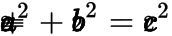
 In Mathematics, the Pythagorean theorem, also known as Pythagoras' theorem, is a fundamental relation in Euclidean geometry among the three sides of a right triangle. It states that the area of the square whose side is the hypotenuse is equal to the sum of the areas of the squares on the other two sides.

Formula:
a^2 + b^2 = c^2
a=side of right triangle
b=side of right triangle
c=hypotenuse

Triangle inequality

Triangle inequality:

 The triangle equality states that for any triangle, the sum of the lengths of any two sides must be greater than or equal to the length of the remaining sides.

Functions

Functions:      A function is a fundamental concept in mathematics, often described as a "black box" that processes an input to p...